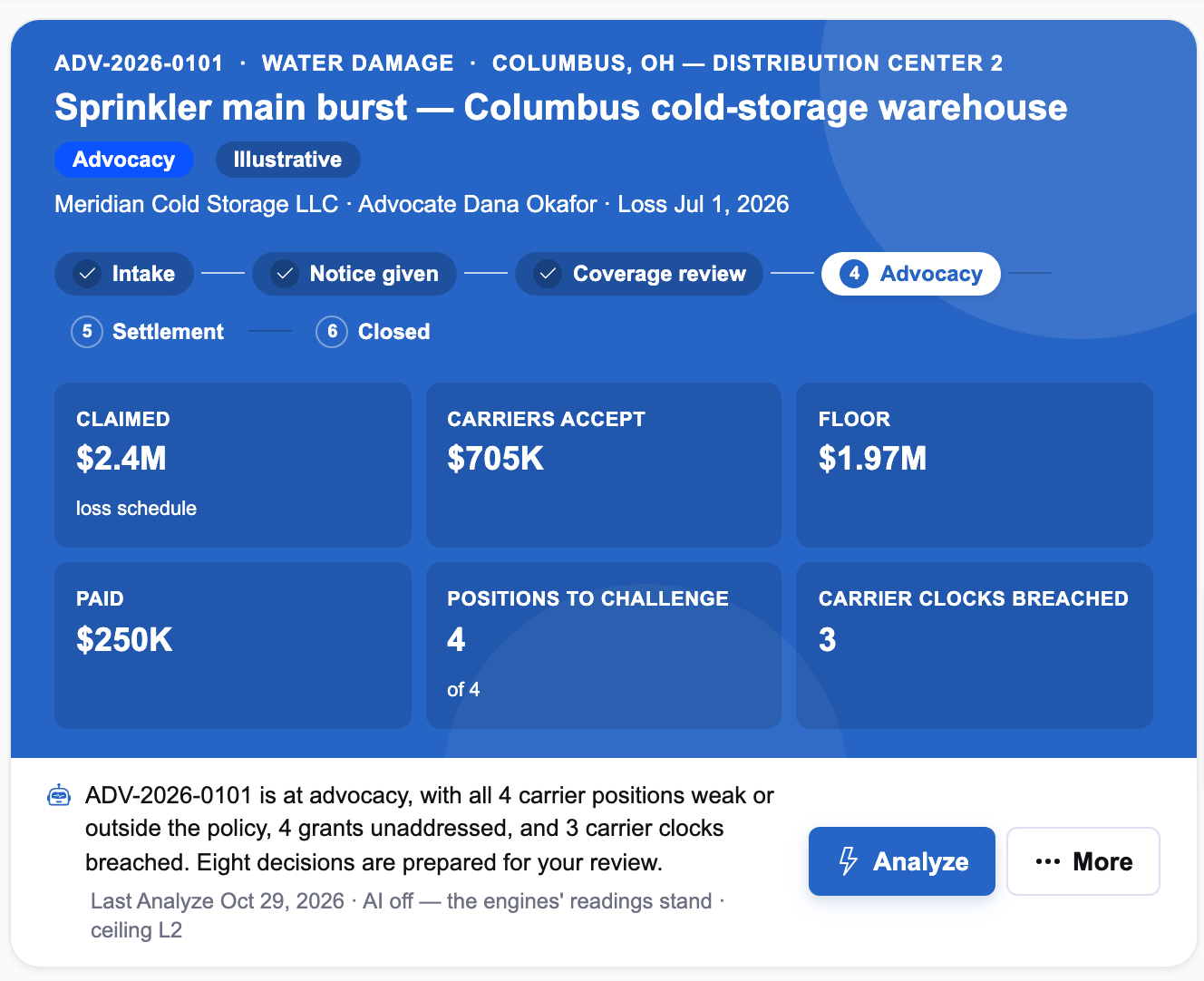
Sooner or later the carrier asks what it would take. The client asks the broker whether to take what’s on the table. Both questions deserve an answer built from the record, line by line — not a gut figure halfway between the claim and the offer.
The settlement engine in InsightAdvocate computes what a claim is worth on the record: every line of the loss schedule, what the carrier accepts, what it disputes, and a weight on each disputed amount from how the carrier’s position on it reads against the wording. This post walks the arithmetic on the illustrative water-damage claim from the first use case.
| Actors | Claims advocate, practice leader, account executive, the client’s CFO |
|---|---|
| Trigger | Analyze, after the coverage engine has assessed the carrier’s positions |
| Agents involved | Settlement evaluator, client update writer, supervisor |
| Decisions and authority | The recommendation to the client (advocate; the practice leader signs off when the carrier is more than 25% below the floor) |
| Outcome | A counter, a floor and the carrier’s position in one table the client can follow |
| What is measured | Final recovery against the floor and against the carrier’s first position |
The weights
| How the carrier’s position on the item reads | Share of the disputed amount expected back |
|---|---|
| Not supported by the policy | 90% |
| Weak | 70% |
| No position yet (unanswered) | 60% |
| Needs facts | 50% |
| Supported by the wording | 15% |
The weights are fixed in the engine, printed under the table on screen, and the same for every claim. They are deliberately simple: a practice can argue with a visible 70%, it cannot argue with a model’s hunch. Rules Studio cannot change them and the model never computes them.
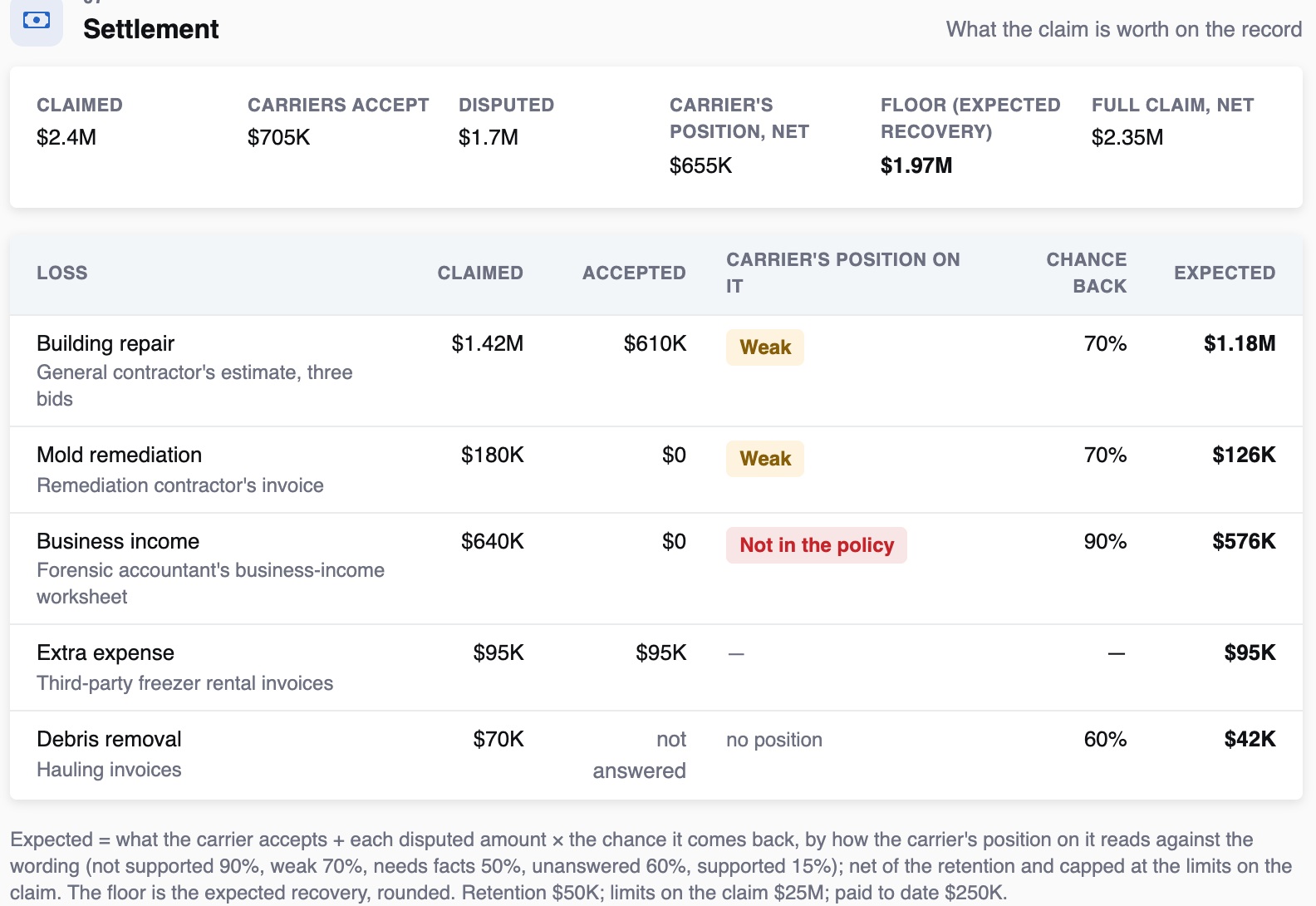
The arithmetic, line by line
| Loss item | Claimed | Accepted | Position | Weight | Expected |
|---|---|---|---|---|---|
| Building repair | $1.42M | $610K | Weak | 70% | $1.18M |
| Mold remediation | $180K | $0 | Weak | 70% | $126K |
| Business income | $640K | $0 | Not in the policy | 90% | $576K |
| Extra expense | $95K | $95K | — | — | $95K |
| Debris removal | $70K | not answered | No position | 60% | $42K |
per item"] --> E["Expected =
accepted + disputed x weight"] D["Disputed
per item"] --> E W["Weight from
the assessment"] --> E E --> N["Net of the retention,
capped at the limits"] N --> F["Floor, rounded"] C["Full claim, net"] --> CT["Counter"] O["Accepted, net"] --> CP["Carrier's position"] style F fill:#ffe4e6,stroke:#e11d48,stroke-width:2px
Expected comes to just over $2.0M; net of the $50K retention and within the $25M limits on the claim,
the floor is $1.97M. The full claim net of the retention, $2.35M, is the counter. The carrier’s
accepted $705K, net, is $655K. The floor sits $1.31M — two thirds of itself — above the
carrier, so SETTLEMENT_GAP (more than 25%) refers the recommendation to the practice
leader before it reaches the client.
The recommendation
Step by step
Each loss item linked to the carrier’s position on it, and the position assessed.
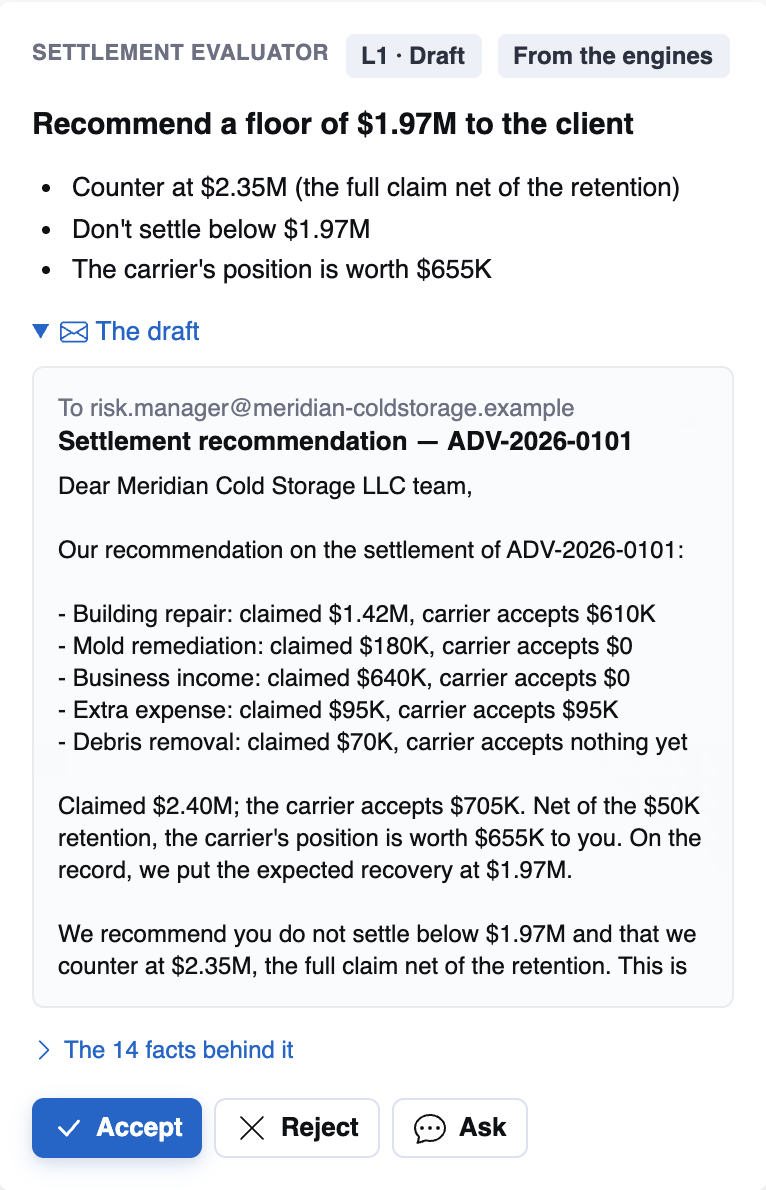
Counter $2.35M, floor $1.97M, carrier’s position $655K; the recommendation drafted with the 14 facts behind it.
SETTLEMENT_GAP refers to the practice leader.
Reviews the table and signs on the decision record.
Accepts the recommendation; it goes to the client as a dry run today.
When the claim settles, the outcome is recorded against the floor.
| Agent | What it prepared | What it cites | Who decides |
|---|---|---|---|
| Settlement evaluator | Counter, floor and the carrier’s position, with the draft to the client | The loss schedule and the engine’s weights | Advocate; lead signs off |
| Client update writer | Where the claim stands | The engines’ figures | Advocate |
The decision record
| Section | Hit | Outcome |
|---|---|---|
| Claim control | SETTLEMENT_GAP: the carrier is more than 25% below the floor | refer |
Questions we get asked
Is the floor what we expect to get?
It is what the record supports with fixed weights. Negotiation, litigation risk and the client’s appetite are judgements the advocate and the client make.
Can the model nudge the floor?
No. The model may explain the table; an explanation with a figure not in the engine’s facts is discarded.
Illustrative: the client, carrier and figures are invented.

