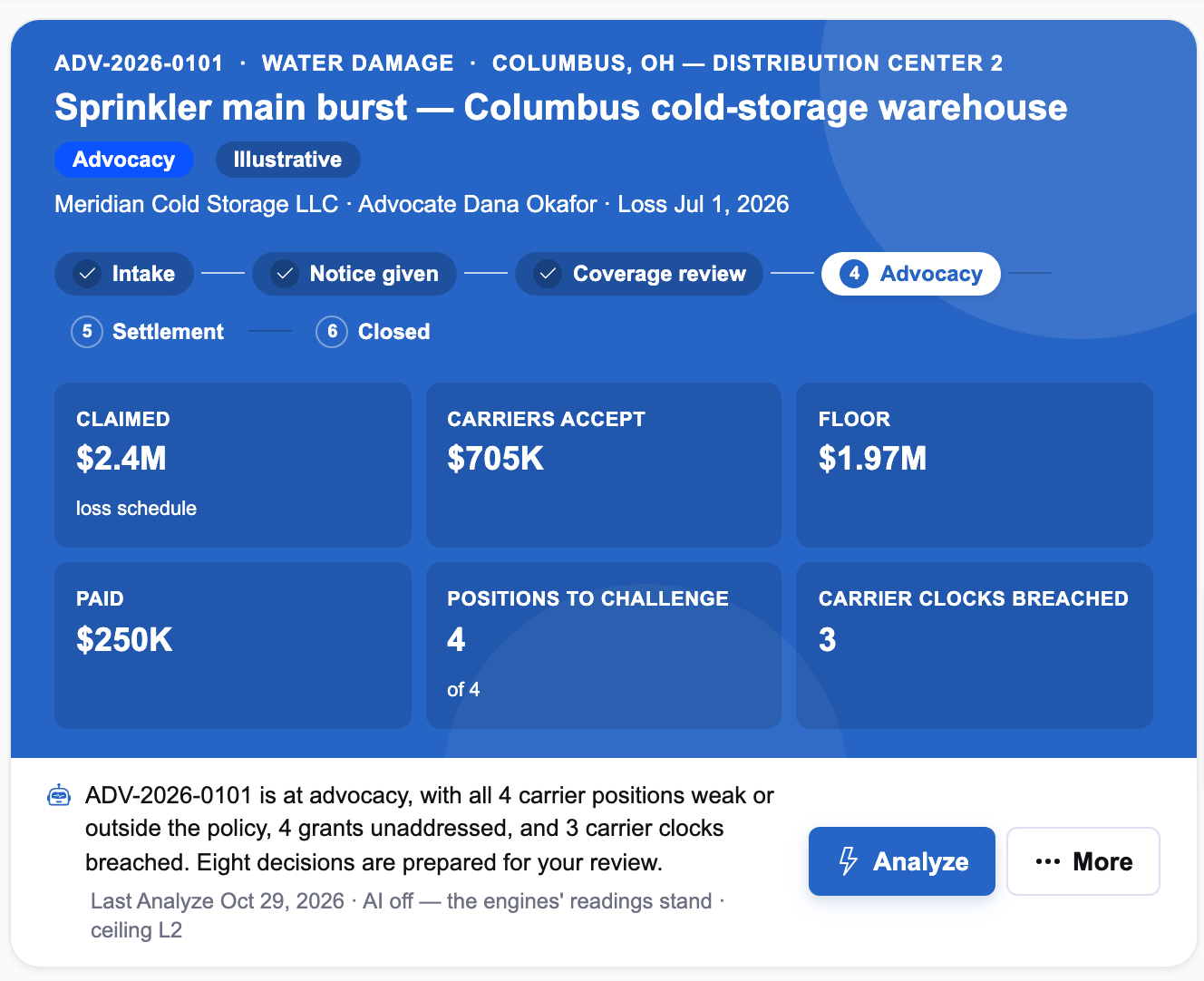
“We are still awaiting the business-income worksheets.” It is the most ordinary sentence in a carrier’s letter and one of the most expensive. While a document the carrier asked for is outstanding, a condition of the policy is a live defence — and the clock on the carrier’s own decision may not be running.
The proof-of-loss coordinator keeps one list per claim: every document the carrier asked for, every one the broker asked for, who owes it, when, and its status. This post follows the list on the illustrative water-damage claim.
| Actors | Claims advocate, the client’s risk manager and finance team, the carrier’s adjuster |
|---|---|
| Trigger | A carrier’s document request recorded; any Analyze |
| Agents involved | Proof-of-loss coordinator, coverage position analyst |
| Decisions and authority | The request to the client and the status of each item (advocate) |
| Outcome | Nothing outstanding that a condition position can rest on; the sworn proof of loss on file and dated |
| What is measured | Items late, days from request to receipt, condition positions that turned weak once everything was sent |
The list

Four items: the business-income worksheets (24 months of monthly P&L) the carrier asked for, owed by the client and late; the lease with the neighbouring tenant the broker asked for, owed by the client and late; repair estimates (three bids) received; and the signed, sworn proof of loss, sent to the carrier by the broker.
Why the list matters to coverage
The coverage engine reads a carrier’s “condition” position against this list. If any document the carrier asked for is still outstanding, the position is supported: the condition is unmet. Once every item has gone to the carrier — sent, received or waived — the same position reads weak. Closing the list moves money: in the settlement arithmetic a supported position carries a 15% weight, a weak one 70%.
for documents"] --> Q{"All sent,
received or waived?"} Q -- "no" --> S["Condition position:
supported"] Q -- "yes" --> W["Condition position:
weak"] S --> P["Request to the client
prepared"] style S fill:#eef2f7,stroke:#8089a8 style W fill:#fff4e2,stroke:#f4a03a
The request to the client

The coordinator drafts the request to the client in plain language: what is needed, by when, and that some items can be estimated or waived if they are hard to get. The advocate sends it (a dry run today) and the list updates as items arrive.
Step by step
Sworn proof of loss, repair estimates and business-income worksheets requested.
The sworn proof of loss goes to the carrier; the illustrative 40-day decision clock starts.
Three bids received.
Worksheets due Oct 24 and the lease due Oct 27 are late; the request to the client drafted.
Accepts; the client is asked (dry run today).
Each item marked as it arrives and goes to the carrier; the next Analyze re-reads any condition position.
| Agent | What it prepared | What it cites | Who decides |
|---|---|---|---|
| Proof-of-loss coordinator | Ask the client for two documents | The requests, who owes them, due dates | Advocate |
| Coverage position analyst | Condition positions read against the list | Document requests | Advocate |
Questions we get asked
Is the sworn proof of loss generated here?
No. The client signs its own proof of loss. InsightAdvocate tracks that it was filed and when, which starts the carrier’s decision clock.
Who updates the list?
The advocate, as items arrive; each change is on the claim’s audit trail.
Illustrative: the client, carrier, items and dates are invented. Regulatory timelines in the product are illustrative models, not legal advice.

