- contact@verticalserve.com
- Part of the Insight broker suite — InsightAdvocate · InsightPlacement · InsightProofing
How it works
Engines compute. Agents prepare. People decide.
InsightAdvocate is AI-first and grounded always: the model reasons over every claim, but every figure and assessment comes from a deterministic engine, and everything that would leave the product waits for a person.
The architecture
From the claim record to the decision record
1
Claim record
Policies and clauses, carrier letters read into positions, the timeline, the loss schedule and requests.
2
Six engines
Notice, coverage, other insurance, SLA, settlement and loss trend. Plain data, every figure cited.
3AI
Ten agents
On the shared insight_agents pipeline, each reasoning over the engines’ numbered facts.
4
Grounding check
A number not in the facts throws the answer away. Fact markers are stripped before anyone reads it.
5
A person decides
Prepared decisions at L1 or L2 wait for the advocate or the practice leader.
6
Decision record
insight_decisions: the run, every claim control that fired, every answer, signed.
Alongside: the engines’ fields feed the claim controls in Rules Studio, which write to the same record; the copilot reads the record through read-only tools.
1 · The engines
Every figure and every assessment, computed and cited
The engines read the claim’s rows and return plain data, each figure with a citation to the wording, the letter, the timeline entry or the loss schedule it rests on. They are tested on known answers.
notice
Per policy: the notice condition, the deadline from the day the client knew, sent on time, late or overdue.
coverage
Each carrier position mapped to the wording: supported, weak, not in the policy, needs facts; grants not addressed.
other insurance
Other lines the facts bring in, excess layers the exposure reaches, the prior claims-made year.
sla
Service-agreement clocks and illustrative regulatory timelines from dated events; the escalation ladder.
settlement
Claimed, accepted, disputed; each disputed amount weighted by its assessment; net of retention; the floor.
loss trend & scorecard
A client’s loss runs by year for the renewal; carriers’ claims handling across the book.
2 · The agents and the grounding check
The model explains what the engines computed. It never makes a number
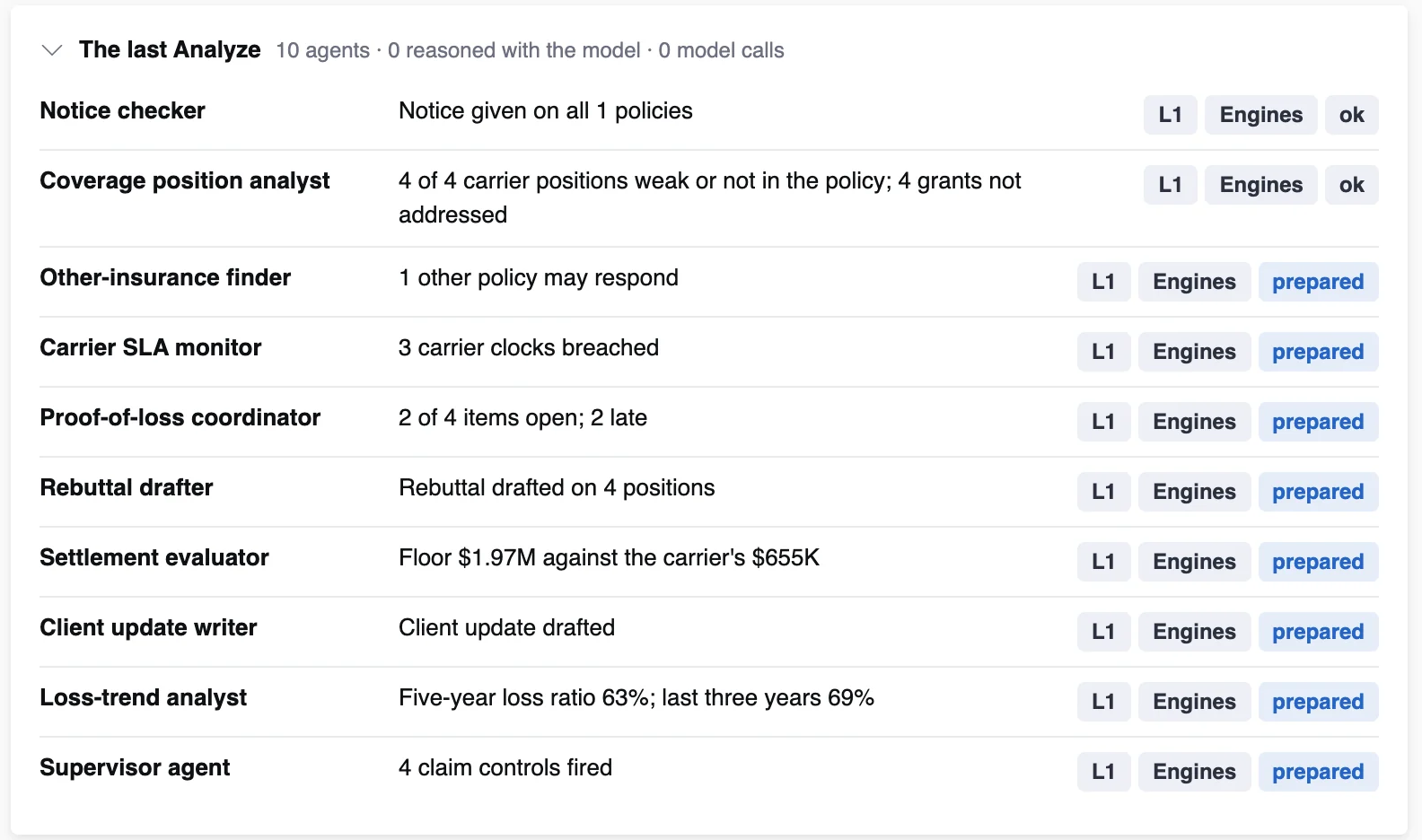
Analyze runs ten agents in order on the shared pipeline, each as itself at its autonomy level. Each reasons over numbered facts with Claude Haiku 5.5 on Amazon Bedrock; an answer carrying a number not in the facts is thrown away and the engine’s findings stand. Fact markers never reach a reader.
sequenceDiagram
  participant U as Advocate
  participant P as Pipeline
  participant E as Engines
  participant M as Model
  participant D as Decision record
  U->>P: Analyze
  loop ten agents in order
    P->>E: Facts for this agent
    E-->>P: Numbered facts with citations
    P->>M: Reason over these facts
    M-->>P: Reading
    P->>P: Grounding check, strip markers
    P-->>U: Prepared decision at L1 or L2
  end
  P->>D: Control hits, the run and its steps
  U->>D: Accept, reject or ask, signed
3 · The autonomy dial
Capped at ask first
The level for an action is the lowest of the agent’s level, the action’s cap and the tenant ceiling (ADVOCATE_AGENTS_MAX_LEVEL). Every action in InsightAdvocate is capped at L2.
L1
Draft
The agent drafts; a person does the work. Where every agent starts.
CeilingL2
Ask first
The agent prepares the decision; a person accepts, rejects or asks.
L3
Act and tell
Locked. A letter to a carrier or client is never sent by an agent.
L4
Act
Locked.
Promotion is earned: 90% agreement over 50 answers recommends a notch, which a practice leader accepts; below 70% over 20 moves it down at once.
4 · Rules Studio and the decision record
Practice standards as claim controls, on the record
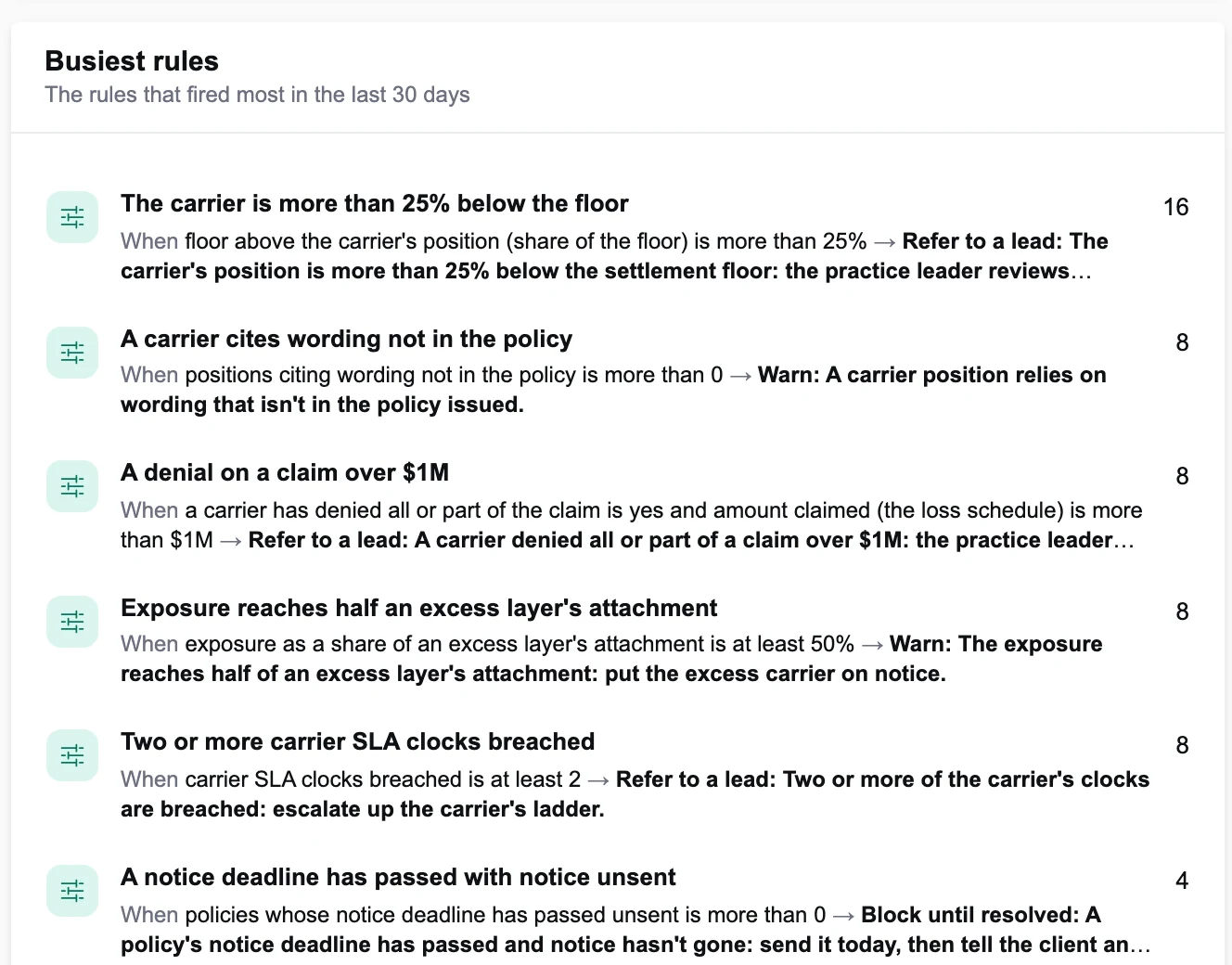
Eight claim controls ship: notice overdue (block), notice due in seven days, unsupported positions, excess reach (warn), large denials, SLA breaches, settlement gaps and large losses (refer to a lead). Each is a sentence over the engines’ fields, tested against open claims before it is published, versioned, and written to the decision record when it fires.
5 · The platform
Built on the shared Insight platform
insight_agents
The agent pipeline, registry, autonomy service, run store and traces.
insight_decisions
The decision record: control hits, answers and sign-offs.
insight_rules · insight_broker
Rules Studio and claim controls; the broker roster.
insight_diligence
The agents’ model kit: the findings schema, citation and grounding helpers.
insight_assist
The claims copilot (Claude Sonnet 5.5): read-only tools, figure checks.
insight_home · insight_identity
Home per persona; sign-in, roles and tenancy.
Regulatory timelines in the SLA engine are illustrative model timelines (configurable), not any state’s law and not legal advice.