A sprinkler main bursts overnight in a cold-storage warehouse. Water runs through two freezer halls and into the neighbouring unit. Six weeks later the carrier’s reservation of rights and partial denial arrives: it accepts $705K of a $2.4M claim. Four sentences in that letter carry the other $1.7M. Each one can be read against the policy the client actually bought.
This post follows one illustrative claim through InsightAdvocate: an invented client (Meridian Cold Storage LLC), an invented carrier (Harrowgate Mutual Insurance) and an invented wording. The figures are what the product’s engines computed on that illustrative record. None of it is a real client, carrier or claim.
| Actors | Claims advocate (owner), account executive, claims practice leader, the client’s risk manager and CFO, the carrier’s adjuster |
|---|---|
| Trigger | A reservation of rights and partial denial read into the claim; Analyze run by the advocate |
| Line | Commercial property, with general liability brought in by damage to a neighbouring tenant |
| Agents involved | Notice checker, coverage position analyst, other-insurance finder, carrier SLA monitor, proof-of-loss coordinator, rebuttal drafter, settlement evaluator, client update writer, loss-trend analyst, supervisor |
| Decisions and authority | Sending the rebuttal and the escalation (advocate), the settlement floor recommended to the client (practice leader sign-off: a denial on a claim over $1M and a floor gap over 25%) |
| Systems touched | None outside InsightAdvocate: every send is a dry run today. The loss brief is prepared for InsightPlacement. |
| Outcome | Four carrier positions answered from the wording, four unaddressed grants raised, the general liability carrier put on notice, a floor of $1.97M against the carrier’s $655K |
| What is measured | Positions challenged and how each resolved, days from the carrier’s letter to the rebuttal, carrier clocks breached, the final recovery against the floor |
Where the letter usually wins
A reservation of rights arrives as prose. It quotes exclusion numbers, names a sublimit, reserves on late notice — and the advocate holding it has thirty other files. The quickest response is to forward it to the client and wait. The second quickest is to argue with it from memory. Neither reads each position against the wording the client was issued.
arrives"] --> B["Forwarded to
the client"] B --> C["Positions argued
from memory"] C --> D["Unaddressed grants
never raised"] D --> E["Settles near the
carrier's number"] style D fill:#fdecec,stroke:#e57373 style E fill:#fff4e2,stroke:#f4a03a
InsightAdvocate turns the letter into rows. Each position is tied to the clause it cites, the coverage engine assesses it against the facts on the record, and the money behind each position is weighted by that assessment in the settlement arithmetic.
read into positions"] --> W["Each position
tied to its clause"] W --> E{"Coverage engine:
supported, weak,
not in the policy,
needs facts"} E --> G["Grants the letter
doesn't address"] E --> S["Settlement floor
from the weights"] G --> R["Rebuttal drafted,
quoting the wording"] S --> P{"Advocate and
practice leader decide"} R --> P style E fill:#ffe4e6,stroke:#e11d48 style P fill:#e8f8f4,stroke:#22c1a4,stroke-width:2px
The claim, as the workspace shows it
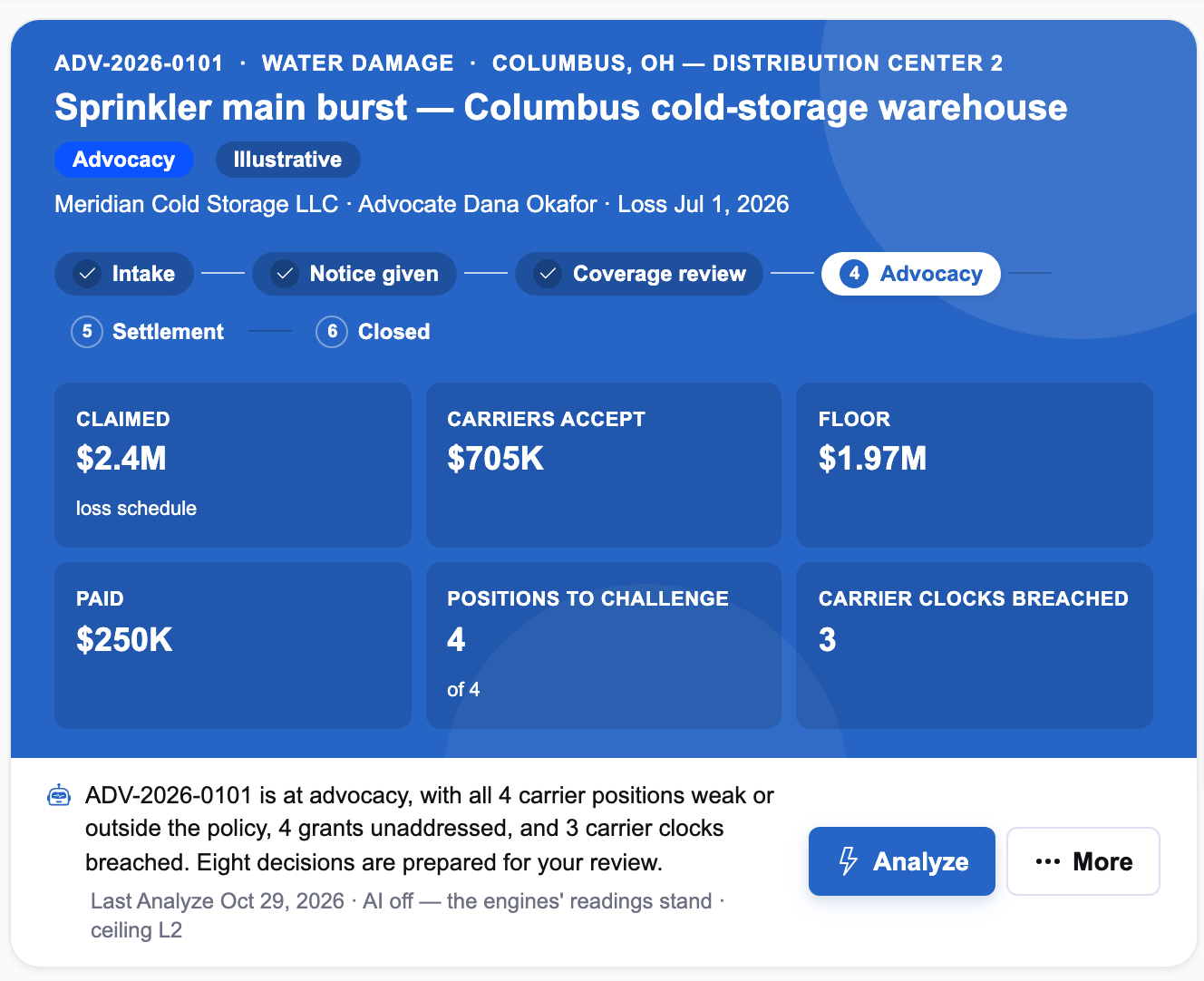
The workspace hero at the top of this post carries the money: $2.4M claimed from the loss schedule, $705K the carrier accepts, a $1.97M floor, $250K paid as an advance, four positions to challenge and three carrier clocks breached. The stage strip says the claim is at Advocacy — past intake, notice and coverage review, not yet at settlement.
Step by step
The sprinkler main bursts in Freezer Hall B; water reaches Halls B and C and the neighbouring unit. The client knew that day, so every notice clock runs from July 1.
Notice went to the property carrier six days after the client knew. The policy’s condition is read from its wording (“as soon as practicable”, read as 30 days), so the deadline was July 31: sent on time.
The reservation of rights and partial denial is read into four positions: an exclusion, a sublimit, a “not covered” and late notice. (Today a stand-in reader does this; InsightXtract is the intended reader.)
Two weak, two not supported by the policy. Four grants the letter never addresses. Every reason is the engine’s, cited to a clause, the loss schedule or the notice record.
Damage to the neighbouring tenant brings in the client’s general liability policy with another carrier. Prepared: put the claim to that policy too.
One letter answering all four positions, each answer quoting the clause it rests on. Held for the advocate.
Counter at $2.35M (the full claim net of the $50K retention); don’t settle below $1.97M; the carrier’s position is worth $655K net.
A denial on a claim over $1M, two or more carrier clocks breached and a floor more than 25% above the carrier’s position: each refers to a lead. A position citing wording not in the policy warns.
The practice leader signs off; the advocate accepts the rebuttal and the escalation. Each answer is signed on the decision record and the letters go — as a dry run today, recorded with a message id.
Position one: the seepage exclusion
The carrier says the building damage results from continuous or repeated seepage, which Exclusion B.3.a removes, and accepts only the portion it attributes to the discharge event. The wording of B.3.a, beside it, ends with a carve-back: the exclusion “does not apply to a sudden and accidental discharge of water from a plumbing, heating or fire-protective sprinkler system.” The loss facts on the record include exactly that — a burst sprinkler main. The engine reads the exclusion as weak: the carve-back the facts meet.

Position two: a sublimit applied beyond its subject
The letter limits “mold remediation and the related repair” to the $250K fungus sublimit in Section C.2 and applies it to the building repair as a whole. The sublimit’s own words cap the cost to remove fungus and repair the damage fungus caused, and say it “does not apply to the water damage from which the fungus resulted.” The engine sums the loss schedule: $180K of the claim is mold work; the letter applies the sublimit to $1.42M. Weak.
Positions three and four: not in the policy

The third position denies business income because the premises were vacant “under Endorsement
CP-44”. The policy issued has no clause CP-44. The letter relies on wording that isn’t in
the client’s policy, so the engine marks it not supported by the policy —
and the Rules Studio control UNSUPPORTED_POSITION warns.
The fourth reserves rights because notice was late and prejudiced the investigation. The notice record says notice went on July 7 against a July 31 deadline. Not supported either.
What the letter didn’t say

Carriers answer what they were asked. The coverage engine also lists the grants in the wording that the facts put in play and the letters never mention: covered causes of loss (A.1), debris removal (A.4.a), preservation of property (A.4.b), and business income and extra expense (A.6). Each becomes a line in the rebuttal.
The rebuttal, as drafted

The rebuttal drafter writes one letter, position by position, from the engine’s reasons. It never invents an argument: each point is the engine’s, with the clause it rests on. The model may shape the prose when it is on; a sentence that carries a figure not in the facts is thrown away and the engine’s text stands.
The money, line by line
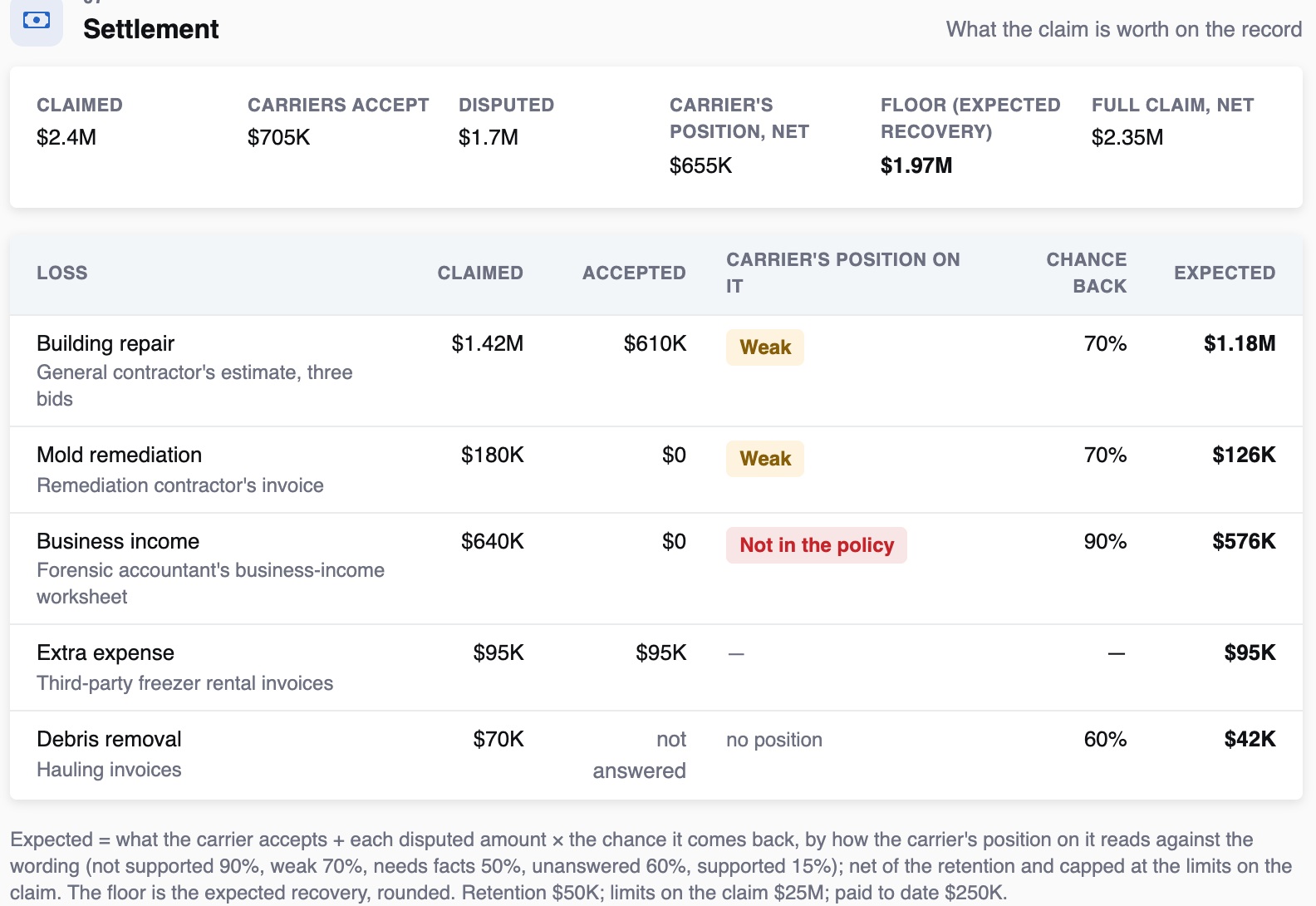
Each line of the loss schedule carries the carrier’s position on it, and the disputed amount is weighted by how that position reads: not supported 90%, weak 70%, unanswered 60%, needs facts 50%, supported 15%. Building repair: $610K accepted plus 70% of the $810K disputed is $1.18M. Business income: 90% of $640K is $576K. Summed and taken net of the $50K retention, the floor is $1.97M. The weights are fixed in the engine and shown on the screen; Rules Studio cannot change them, and the model never computes them.
What the agents prepared, and what each rests on

| Agent | What it prepared | What it cites | Who decides |
|---|---|---|---|
| Other-insurance finder | Put the claim to the general liability policy | The loss facts (a neighbouring tenant damaged), the client’s program | Advocate |
| Proof-of-loss coordinator | Ask the client for the business-income worksheets and the neighbouring tenant’s lease | The document requests and their due dates | Advocate |
| Carrier SLA monitor | Escalate the carrier: three commitments breached | The service-agreement clocks and the escalation ladder | Advocate |
| Rebuttal drafter | Answer four positions | The engine’s assessments, cited to clauses | Advocate |
| Settlement evaluator | Recommend a $1.97M floor to the client | The loss schedule and the weights | Advocate; lead signs off |
| Client update writer | Status update to the client | The claim’s stage and the engines’ figures | Advocate |
| Loss-trend analyst | Brief the placement team: renews in 75 days | Five years of loss runs | Account executive |
| Supervisor agent | Practice leader sign-off: three controls | The published claim controls | Practice leader |
Where the claim is, as states
Edge cases
| What happens | What InsightAdvocate does |
|---|---|
| The exclusion really does reach the facts | The engine says supported, the rebuttal leaves it out, and its money carries a 15% weight. The advocate is told, not flattered. |
| Notice was a few days late | Up to 30 days late, the position reads weak: the rebuttal asks the carrier how the delay harmed its investigation. Beyond that, supported. |
| A loss item has no position at all | It is “unanswered” and weighted 60% — debris removal here, $70K claimed, $42K expected. |
| The carrier writes again | The new letter is read into new positions and the engines run again. Old assessments stay on the record with their date. |
The decision record for this claim
| Section | Hit | Outcome |
|---|---|---|
| Claim control | LARGE_DENIAL: a carrier denied all or part of a claim over $1M | refer |
| Claim control | SLA_BREACHES: two or more carrier clocks breached | refer |
| Claim control | SETTLEMENT_GAP: the carrier is more than 25% below the floor | refer |
| Claim control | UNSUPPORTED_POSITION: a position cites wording not in the policy | warn |
| Prepared | Rebuttal of four positions, accepted by the advocate (dry-run send) | proceed |
For the claims advocate
One page instead of a letter, a policy PDF and a spreadsheet. The rebuttal arrives drafted and cited; your job is to judge it.
For broker IT
Every assessment is a deterministic function of the record, so it can be tested on known answers. The model only explains.
For practice leadership
The floor is defensible line by line, and the sign-off is on the record before anything reaches the client.
Questions we get asked
Does the product decide coverage?
No. It reads the carrier’s positions against the wording and says how each reads. The advocate — and where it matters, coverage counsel — decides what to argue.
Is the floor a prediction of the settlement?
No. It is what the claim is worth on the record with fixed, visible weights. It is a negotiating anchor, not a forecast.
Did these letters really go to a carrier?
No. Every send in InsightAdvocate is a dry run today: recorded with a message id, nothing leaves the product.
Illustrative: the client, carrier, wording and figures in this post are invented. Regulatory timelines shown in the product are illustrative models, not legal advice.

