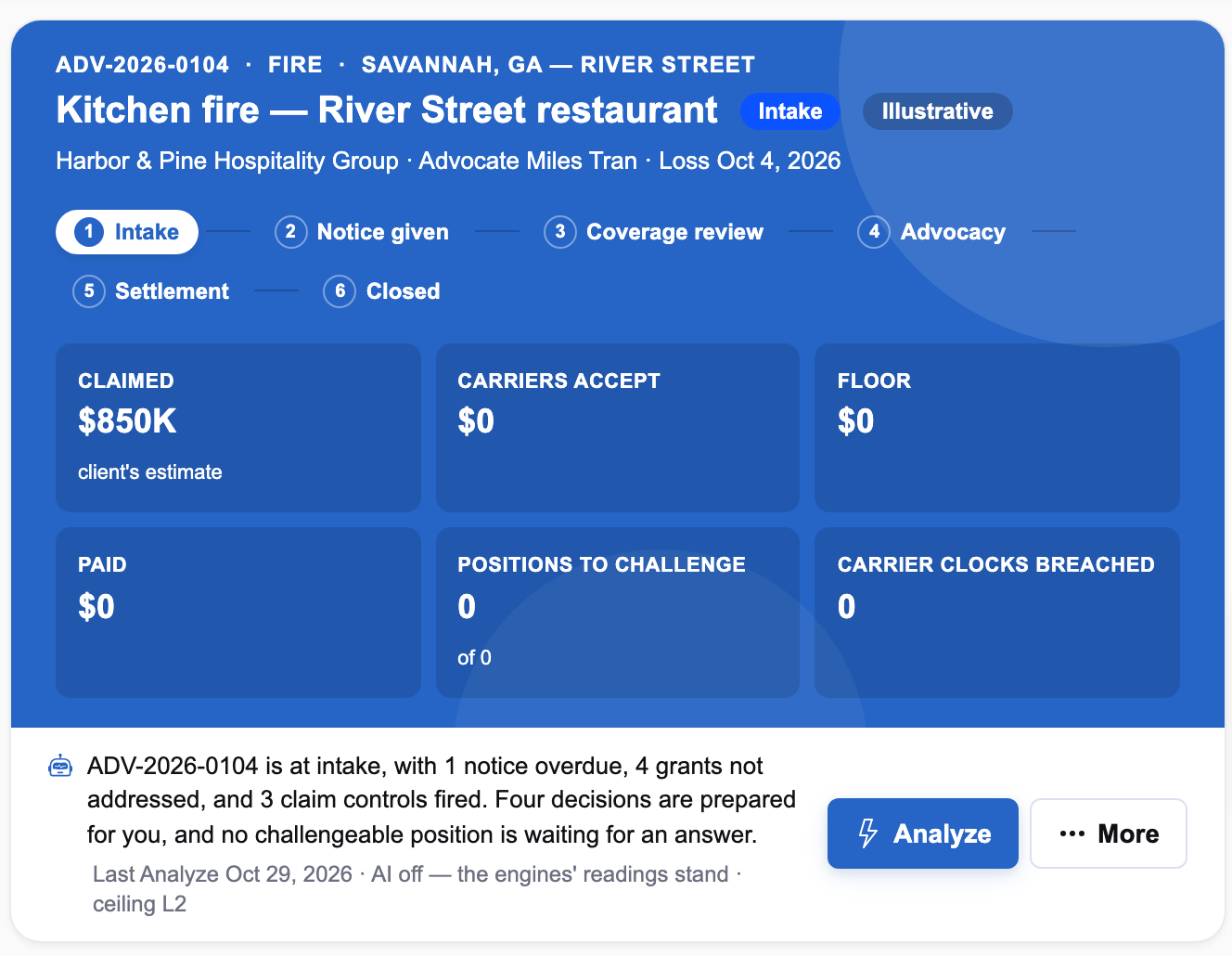
A grease fire in a restaurant kitchen spreads to the retail unit next door, and the fire marshal closes the block for three days. The client calls the account executive the same afternoon. Everyone thinks of the property policy. Nobody thinks of the general liability policy — whose notice condition is shorter, and whose deadline passes while the property adjuster is still being assigned.
Notice is the cheapest coverage defence a carrier has and the easiest one for a broker to give away. This post follows an illustrative kitchen fire (an invented client, Harbor & Pine Hospitality Group, and invented carriers) at intake, where InsightAdvocate reads each policy’s notice condition from its wording and works out every deadline from the day the client knew.
| Actors | Claims advocate (owner), account executive, practice leader, the client |
|---|---|
| Trigger | A new claim opened at intake; Analyze |
| Lines | Property (primary), general liability (other line), umbrella (excess) |
| Agents involved | Notice checker, other-insurance finder, client update writer, supervisor |
| Decisions and authority | Sending each notice (advocate); the practice leader is told when a deadline has passed |
| Outcome | Notice drafted to both carriers, the overdue one first; the umbrella carrier flagged before the exposure reaches its attachment |
| What is measured | Notices sent after their deadline (the number to drive to zero), days from the loss to the last notice, excess carriers on notice before attachment |
The clock starts when the client knew
Policies don’t share a notice condition. One says “as soon as practicable” and the practice reads it as 30 days; another names 20 days in its declarations; a claims-made policy says “within 60 days and no later than 60 days after the policy expires”. The notice checker reads each policy on the claim for the loss type and computes its deadline from the date the client knew of the loss.

Here the client knew on October 4. The property notice under a 30-day condition is due November 3 — five days left. The general liability notice, under a 20-day condition, was due October 24. It is five days overdue.
condition: 30 days
due in 5 days"] K --> G["General liability policy
condition: 20 days
overdue by 5"] K --> U["Umbrella
exposure at 85%
of its attachment"] G --> B{"NOTICE_OVERDUE
blocks"} P --> W1["NOTICE_DUE_7D
warns"] U --> W2["EXCESS_REACH
warns"] style B fill:#fdecec,stroke:#e57373 style W1 fill:#fff4e2,stroke:#f4a03a style W2 fill:#fff4e2,stroke:#f4a03a
The block, and what was prepared

The claim control NOTICE_OVERDUE is published as a block: a red banner sits across the
workspace saying a policy’s notice deadline has passed and notice hasn’t gone —
send it today, then tell the client and the practice leader. Underneath, the notice checker has
already drafted both notices, the overdue one first.

Each notice names the client, the policy and its period, the date and place of the loss, what happened in the client’s words, and the client’s first estimate ($850K, still being quantified). The advocate reads them, accepts, and they go — as a dry run today, recorded on the claim with a message id.
Step by step
Kitchen fire; the adjoining retail unit damaged; the block closed by the fire marshal for three days.
Operations stopped, access prohibited by the authorities, debris to remove, damage to a neighbouring tenant. Each fact can bring in a line or a grant.
Property: due November 3. General liability: overdue since October 24. Both notices drafted.
The $850K estimate is 85% of the umbrella’s $1M attachment. Excess carriers expect notice well before their layer is reached. Prepared: put the claim to the umbrella.
Block on the overdue notice; warnings on the deadline within seven days and on excess reach. The practice leader’s sign-off is prepared.
Accepts the notices (dry run), then the client update. The decision record keeps each answer and the date.
What the agents prepared
| Agent | What it prepared | What it cites | Who decides |
|---|---|---|---|
| Notice checker | Notices to two carriers, one overdue | Each policy’s notice clause; the date the client knew | Advocate |
| Other-insurance finder | Put the claim to the umbrella | The estimate against the layer’s attachment | Advocate |
| Client update writer | Status update at intake | The claim’s stage and figures | Advocate |
| Supervisor agent | Practice leader sign-off: a notice deadline passed | NOTICE_OVERDUE | Practice leader |
Edge cases
| What happens | What InsightAdvocate does |
|---|---|
| The policy says “as soon as practicable” | The practice’s reading is applied and shown on the card (here, 30 days), with the clause cited, so anyone can disagree with it. |
| A claims-made policy | The condition is the reporting window and the policy’s expiry; see the D&O post. |
| Notice goes late anyway | The record shows it late. If the carrier later reserves on it, the coverage engine reads the position: weak up to 30 days late, asking how the delay prejudiced it. |
| The estimate grows | Excess reach is recomputed on every Analyze; a layer the exposure reaches gets its own notice. |
The decision record for this claim
| Section | Hit | Outcome |
|---|---|---|
| Claim control | NOTICE_OVERDUE: a notice deadline has passed with notice unsent | block |
| Claim control | NOTICE_DUE_7D: a notice deadline is within seven days | warn |
| Claim control | EXCESS_REACH: exposure reaches half an excess layer’s attachment | warn |
Questions we get asked
Is the deadline legal advice?
No. It is the policy’s own notice condition read from its wording, with the practice’s reading of vague terms shown. Whether a late notice prejudices coverage is a legal question for counsel.
Who chooses the reading of “as soon as practicable”?
The practice. It is configuration, shown on every notice card, not something the model decides.
Can the agent send a notice on its own?
No. Sending to a carrier is capped at ask first (L2), whatever the dial says.
Illustrative: the client, carriers, wordings and figures are invented. Notice conditions shown are read from invented wordings; nothing here is legal advice.

