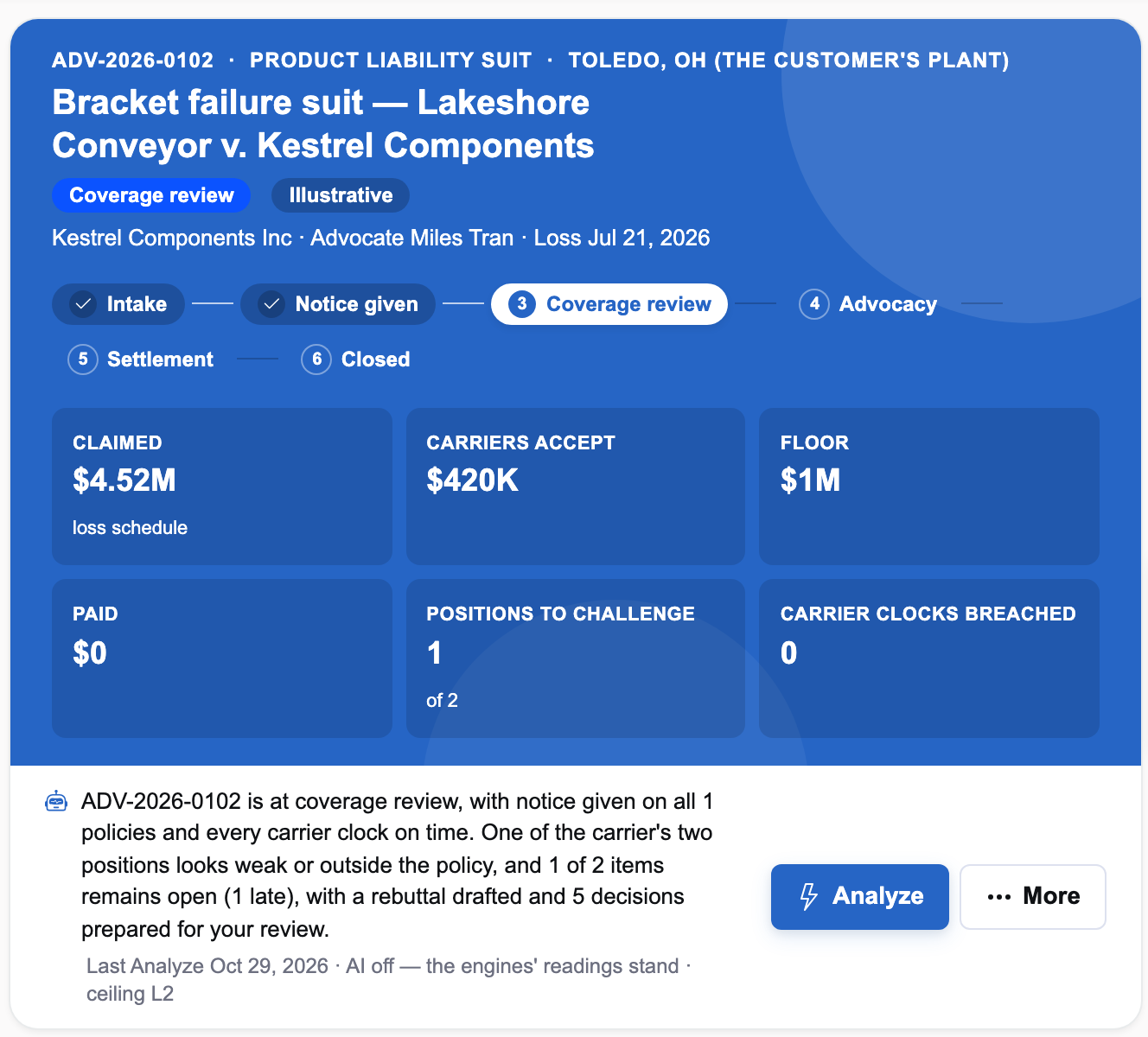
A conveyor bracket fails at a customer’s plant and the customer sues the manufacturer that supplied it. The demand is $4.52M. The primary general liability policy has a $1M limit and its carrier has reserved rights. Above it sit an umbrella and an excess layer — and neither of those carriers has heard a word.
Liability claims climb. The broker’s job is to make sure each layer is on notice before the exposure reaches it, and that the primary carrier’s reservation is read properly while it is still only a reservation. This post follows an illustrative suit (an invented client, Kestrel Components Inc, and invented carriers) through InsightAdvocate.
| Actors | Claims advocate, account executive, practice leader, defence counsel appointed by the carrier |
|---|---|
| Trigger | A reservation of rights read into the claim; Analyze |
| Lines | General liability (primary), umbrella and excess |
| Agents involved | Coverage position analyst, other-insurance finder, rebuttal drafter, settlement evaluator, supervisor |
| Decisions and authority | Notice to the excess layers and the response to the reservation (advocate); sign-off on the settlement gap (practice leader) |
| Outcome | The contractual-liability exclusion answered with its carve-back, the carrier asked to name the clause behind its general reservation, the umbrella put on notice |
| What is measured | Excess layers on notice before the exposure reaches them, reservations answered within the practice’s target |
Two positions, read against the wording

The first position says that to the extent the plaintiff seeks to hold the client liable under the indemnity in the supply agreement, Exclusion I.A.2.b (contractual liability) excludes it. The exclusion’s own last sentence says it does not apply to liability assumed in an “insured contract” — and the facts on the record include an indemnity of that kind. The engine reads the position as weak.
The second is a general reservation “on all other terms of the policy”. It names no wording, so there is nothing to assess. The engine says needs facts, and the rebuttal asks the carrier which clause it relies on and why. A general reservation that is never challenged tends to become a specific one at the worst moment.
facts meet?"} X -- "yes" --> WK["Weak"] X -- "no, words reach facts" --> SP["Supported"] T -- "general reservation" --> NF["Needs facts:
ask which clause"] T -- "cites a clause
not in the policy" --> NS["Not supported
by the policy"] style WK fill:#fff4e2,stroke:#f4a03a style NF fill:#e8efff,stroke:#5b7bd6 style NS fill:#fdecec,stroke:#e57373
The tower, and who is on notice

The program zone draws the client’s liability tower: Northwind Specialty Casualty’s $1M
primary (on the claim, in blue), Bramblecrest Indemnity’s $10M xs $1M umbrella and Corvane
Excess & Surplus’s $15M xs $11M (amber: not on notice yet). The exposure on the claim
— $4.52M — is 452% of the umbrella’s attachment. The other-insurance finder
prepares the notice; EXCESS_REACH warns once exposure passes half an attachment, so the
warning would have fired long before this.
Step by step
Sent four days after the client knew, inside a 30-day condition; acknowledged two days later.
Read into two positions: the contractual-liability exclusion and a general reservation.
One weak (the insured-contract carve-back), one needs facts (no wording named).
The umbrella is reached; its notice is prepared. The excess layer above follows as the exposure moves.
A floor of about $1M against the carrier’s accepted position; the gap is more than 25%.
SETTLEMENT_GAP refers to the practice leader; EXCESS_REACH warns.
The reservation is answered and the umbrella carrier is noticed — both as dry runs today — and the sign-off is on the record.
What the agents prepared
| Agent | What it prepared | What it cites | Who decides |
|---|---|---|---|
| Coverage position analyst | Two assessments and the grants not addressed | Clause I.A.2.b and the facts on file | Advocate |
| Other-insurance finder | Notice to the umbrella | Exposure against the layer’s attachment | Advocate |
| Rebuttal drafter | Answer the exclusion; ask for the clause behind the reservation | The engine’s reasons | Advocate |
| Supervisor agent | Practice leader sign-off | SETTLEMENT_GAP | Practice leader |
Edge cases
| What happens | What InsightAdvocate does |
|---|---|
| The indemnity isn’t an insured contract | If the facts don’t include it, the exclusion’s words reach the facts and the engine says supported. The advocate sees that, too. |
| The suit is dismissed | Exposure drops on the next Analyze; excess reach clears; the record keeps what was sent and when. |
| A layer sits with a surplus lines market | It is treated like any other layer: its attachment and limit come from the policy record. |
The decision record for this claim
| Section | Hit | Outcome |
|---|---|---|
| Claim control | SETTLEMENT_GAP: the carrier is more than 25% below the floor | refer |
| Claim control | EXCESS_REACH: exposure reaches half an excess layer’s attachment | warn |
Questions we get asked
Does InsightAdvocate manage the defence?
No. Defence counsel is the carrier’s. InsightAdvocate keeps the broker’s side: notice, positions, the tower and the client.
Where does the tower come from?
From the client’s policies on record: each layer’s attachment and limit, as recorded in InsightAdvocate.
Illustrative: the client, carriers, wordings and figures are invented. Nothing here is legal advice.

