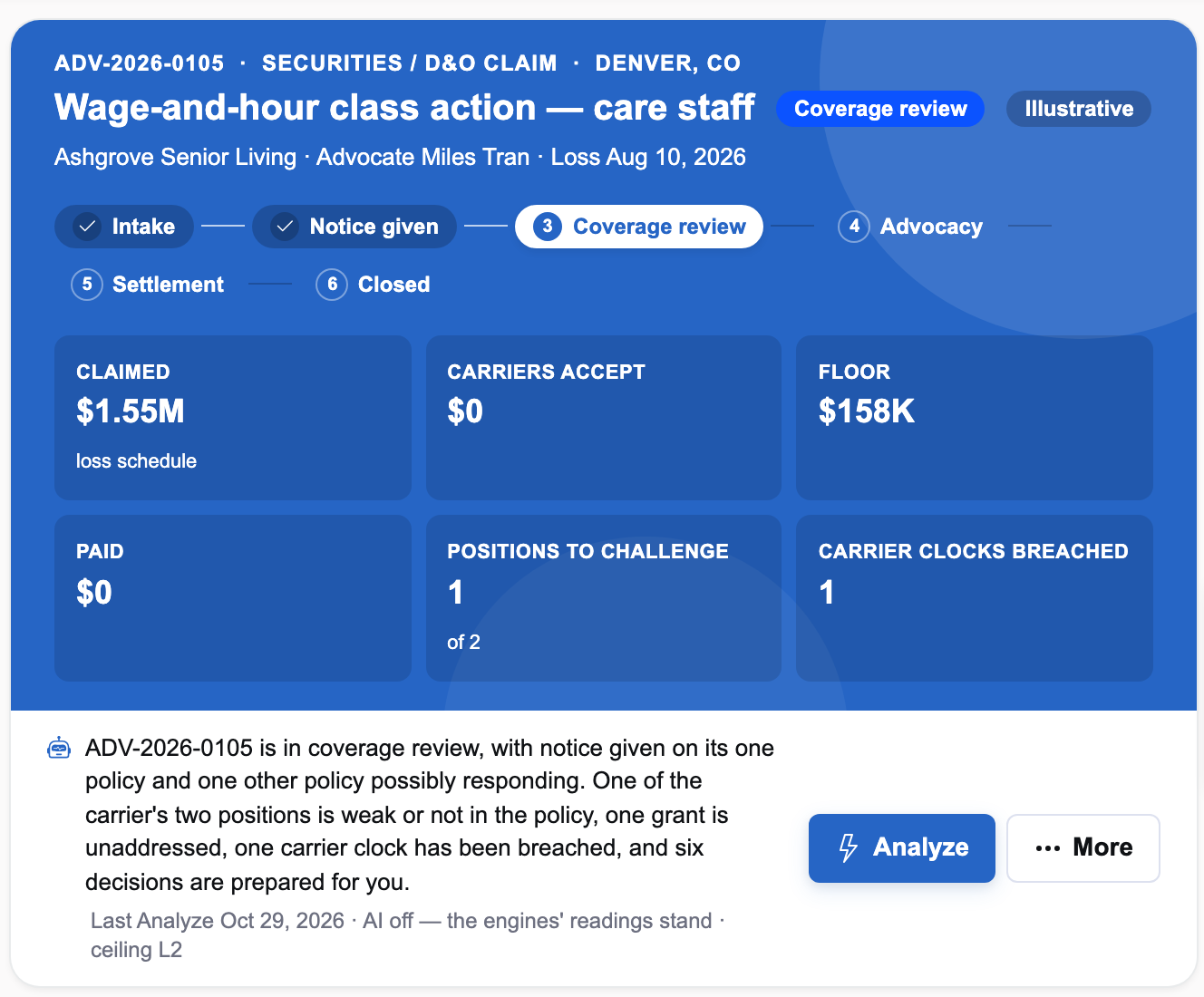
Care staff at a senior-living operator bring a wage-and-hour class action. The client reports it under its directors-and-officers policy, and the carrier declines: the claim arises from circumstances the client knew of before inception, and notice was late anyway. One of those two positions is strong. The other is not. And the letter doesn’t mention the part of the policy written for exactly this kind of claim.
An honest advocate needs to know which positions to fight and which to concede. This post follows an illustrative D&O denial (an invented client, Ashgrove Senior Living, and an invented carrier, Corvane Excess & Surplus) through InsightAdvocate’s coverage and other-insurance engines.
| Actors | Claims advocate, practice leader, coverage counsel, the client’s general counsel |
|---|---|
| Trigger | A declination of coverage read into the claim; Analyze |
| Line | Directors & officers on a claims-made form, with an employment practices grant |
| Agents involved | Notice checker, coverage position analyst, other-insurance finder, rebuttal drafter, settlement evaluator, supervisor |
| Decisions and authority | What to contest (advocate with counsel), sign-off on a denial over $1M (practice leader) |
| Outcome | The late-notice position answered, the prior-knowledge exclusion conceded on the facts as they stand, the EPL grant raised, the prior claims-made year put on notice |
| What is measured | Positions conceded versus contested, and how each resolved |
A claims-made notice condition
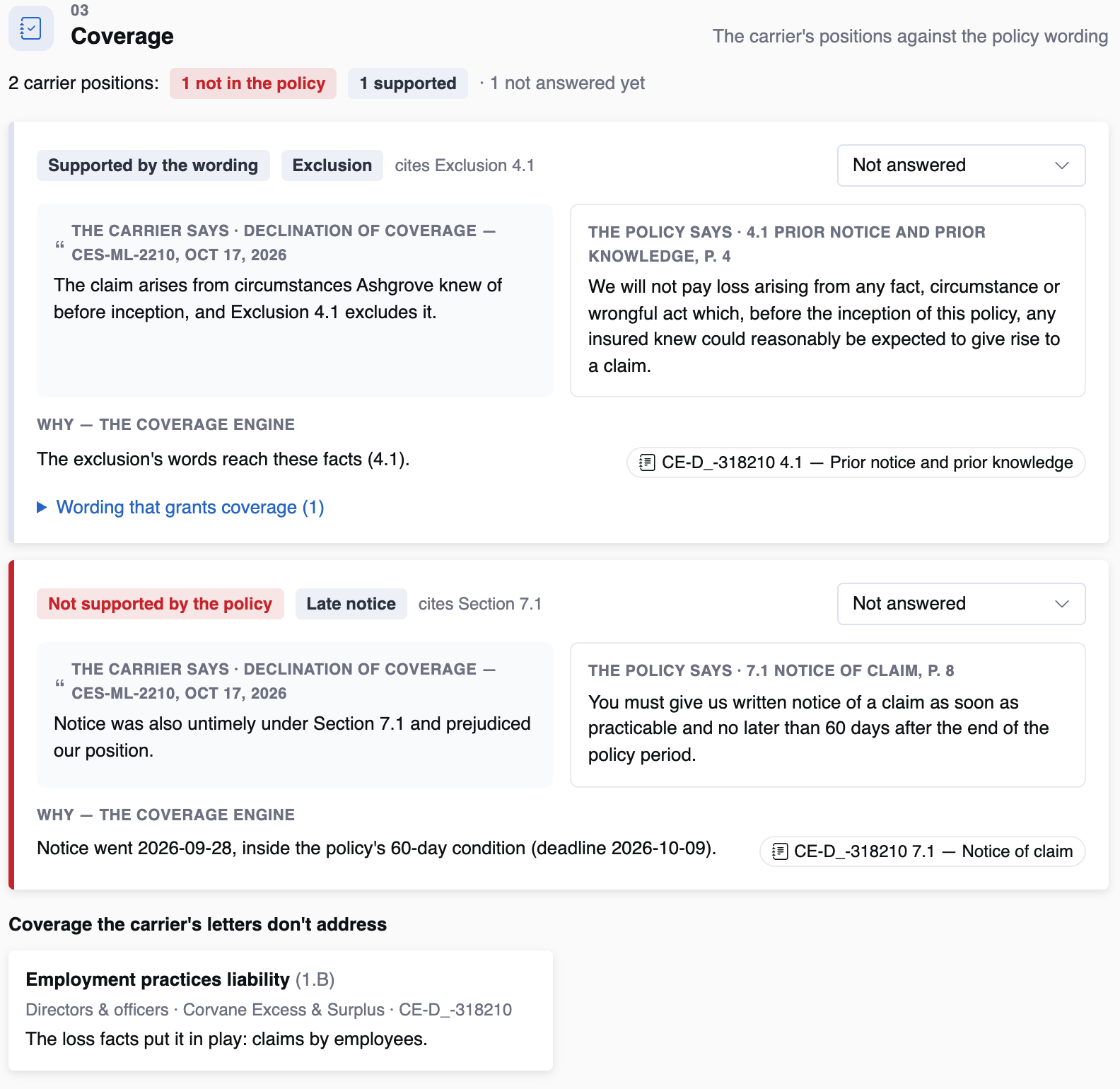
The client knew of the claim on August 10 and notice went on September 28 — 49 days later. On an occurrence policy with a 30-day reading that would be late. This is a claims-made form: report within 60 days and no later than 60 days after the policy expires. The notice checker computes a deadline of October 9 from the wording, so notice was on time.
One position holds, one doesn’t
The carrier’s first position relies on Exclusion 4.1, prior notice and prior knowledge: no payment for loss arising from circumstances an insured knew before inception could give rise to a claim. The facts on the record include exactly that. The engine says supported by the wording, and the rebuttal does not pretend otherwise.
The second says notice was untimely under Section 7.1. It wasn’t: the engine shows the notice date inside the 60-day condition and marks the position not supported by the policy. And the letter is silent on the employment practices liability grant (1.B), which the facts put in play: the claim is by employees.
concede, look elsewhere"] N --> U["Not supported:
notice inside 60 days"] S --> PY["Prior claims-made year
may respond"] D -.-> G["EPL grant 1.B
not addressed"] style S fill:#eef2f7,stroke:#8089a8 style U fill:#fdecec,stroke:#e57373 style PY fill:#fff4e2,stroke:#f4a03a style G fill:#fff4e2,stroke:#f4a03a
The prior year
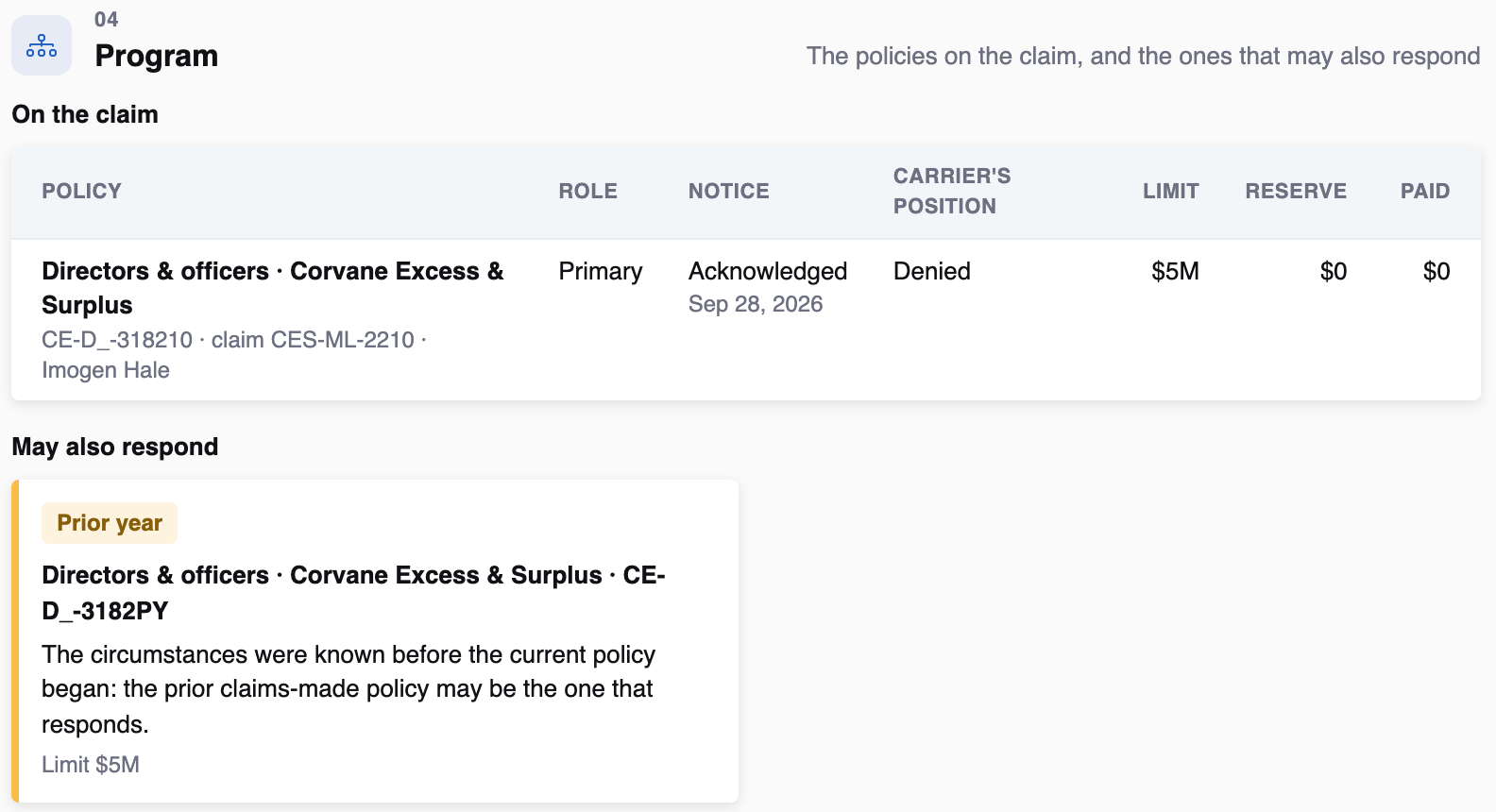
If the circumstances were known before this policy began, the question becomes whether they were reported — or reportable — under the policy before it. The other-insurance finder lists the prior claims-made year with the same carrier as a policy that may respond, and prepares notice to it. Whether it does respond is for the carrier, counsel and the wording; the product makes sure the question is asked in time.
Step by step
A class action by care staff is filed.
Sent 49 days later, inside the claims-made 60-day condition; acknowledged Oct 5.
Read into two positions: prior knowledge (4.1) and late notice (7.1).
4.1 supported; 7.1 not supported; the EPL grant unaddressed.
The prior claims-made year may respond; notice prepared.
LARGE_DENIAL and SETTLEMENT_GAP refer; UNSUPPORTED_POSITION warns.
Concede what the wording supports, answer what it doesn’t, raise the grant, notice the prior year — all as dry runs today, all signed on the record.
What the agents prepared
| Agent | What it prepared | What it cites | Who decides |
|---|---|---|---|
| Coverage position analyst | One supported, one not supported, one grant unaddressed | Clauses 4.1, 7.1 and 1.B; the notice record | Advocate with counsel |
| Other-insurance finder | Notice to the prior claims-made year | The program and the prior-knowledge fact | Advocate |
| Rebuttal drafter | Answer 7.1; raise 1.B | The engine’s reasons | Advocate |
| Settlement evaluator | A floor of $158K against the carrier’s $0 | The loss schedule and the weights | Practice leader signs off |
The floor here is low for a reason: the supported exclusion carries a 15% weight. That is the engine being honest with the client about where the money is likely to come from — which may be the prior year.
The decision record for this claim
| Section | Hit | Outcome |
|---|---|---|
| Claim control | LARGE_DENIAL: a denial on a claim over $1M | refer |
| Claim control | UNSUPPORTED_POSITION: a carrier position not supported by the policy | warn |
| Claim control | SETTLEMENT_GAP: the carrier is more than 25% below the floor | refer |
Questions we get asked
Why would the product concede a position?
Because the wording supports it on the facts as recorded. Arguing a supported exclusion costs credibility the advocate needs for the positions that are weak.
Is this coverage advice?
No. It is a structured reading of the carrier’s positions against the wording on record. Coverage counsel advises.
Illustrative: the client, carrier, wording and figures are invented. Nothing here is legal advice.

