A carrier agrees, in a claims service agreement with the broker, to acknowledge a notice within two days, have the adjuster call the client within three, state a coverage position within thirty and report on status every thirty. On a large claim those promises are kept, nearly kept, or quietly forgotten — and nobody on the broker’s side is counting.
About the regulatory timelines
Alongside each carrier’s service-agreement terms, InsightAdvocate runs a set of illustrative model regulatory timelines (acknowledge 15 days, decide 40 days after proof of loss, pay 30 days after agreement, answer correspondence 15 days). They are configurable examples, not any state’s law, and nothing in the product or this post is legal advice. A practice sets the timelines its counsel confirms.
| Actors | Claims advocate, practice leader, the carrier’s adjuster and claims supervisor |
|---|---|
| Trigger | Any Analyze on a claim with a carrier on it; the carrier’s clocks are recomputed from the timeline |
| Agents involved | Carrier SLA monitor, supervisor |
| Decisions and authority | Escalating to the next rung of the carrier’s ladder (advocate); two or more breaches refer to the practice leader |
| Outcome | A cited escalation letter, the carrier’s scorecard updated across every claim |
| What is measured | Clocks met on time per carrier, days to acknowledge, escalations and what followed |
Clocks from the timeline
Every clock starts and stops on an event in the claim’s timeline: notice sent, acknowledgement received, the adjuster’s first call, the coverage letter, proof of loss filed, the broker’s last unanswered letter. The SLA engine needs no one to tick a box — it reads the dated events and says met, met late, breached or not started, with the days over.


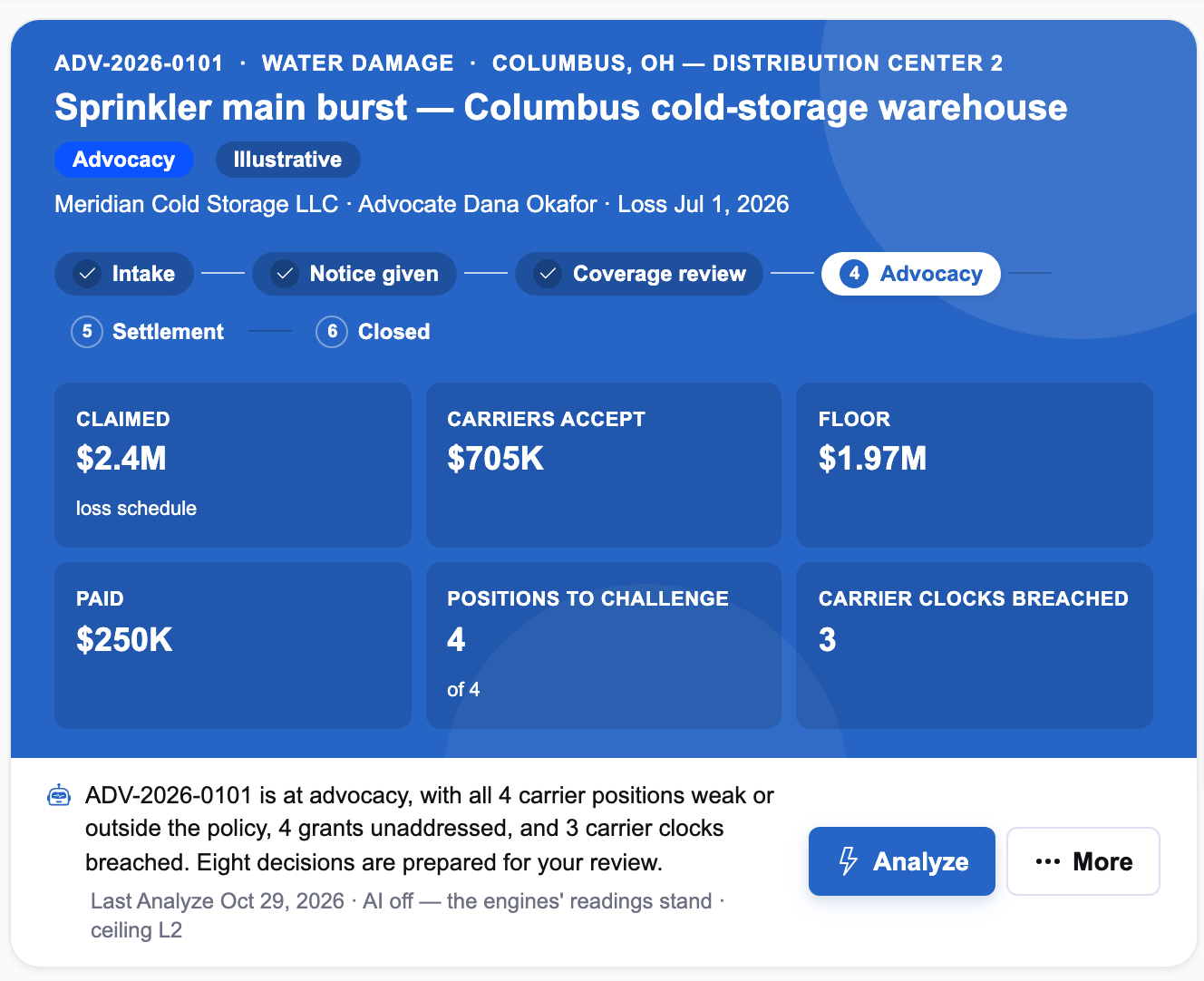
On this illustrative property claim the carrier acknowledged five days late, called the client seven days late and stated its coverage position five days late. On the illustrative regulatory timelines, its decision after the sworn proof of loss is 30 days overdue, the broker’s October 4 request has gone unanswered 10 days past its window, and the 30-day status report is 30 days overdue. Three breached, 14% on time.
The ladder
Each carrier record carries its escalation ladder — the adjuster, then the claims supervisor, and on up the rungs the carrier agreed. The SLA monitor prepares the escalation to the next rung, citing each breached commitment, its basis and its dates. Here: from the adjuster to the claims supervisor.

Step by step
Notice sent: acknowledge, contact and coverage-position clocks start.
Sworn proof of loss filed: the 40-day decision clock (illustrative) starts.
The advocate asks the adjuster for the coverage decision: the 15-day reply clock starts.
Three breached; the escalation to the claims supervisor drafted with the facts behind it.
SLA_BREACHES (two or more) refers to the practice leader.
Accepts; the letter goes as a dry run today and the ladder moves up a rung.
Across the book: the scorecard

The same clocks roll up into a carrier claims-handling scorecard across every claim on record: claims, days to acknowledge, clocks met on time, clocks breached, positions weak or not in the policy, the share of claimed amounts accepted, and paid. It is computed from the claims on this record only, so on a small illustrative book it says little; on a real book it is the evidence a practice leader brings to a carrier stewardship meeting.
| Agent | What it prepared | What it cites | Who decides |
|---|---|---|---|
| Carrier SLA monitor | Escalate to the next rung | Each clock’s basis, start, due and met dates | Advocate |
| Supervisor agent | Practice leader sign-off | SLA_BREACHES | Practice leader |
The decision record
| Section | Hit | Outcome |
|---|---|---|
| Claim control | SLA_BREACHES: two or more carrier SLA clocks breached | refer |
Questions we get asked
Where do the service-agreement terms come from?
From each carrier’s record in InsightAdvocate. With none set, defaults apply (acknowledge 2 days, contact 3, position 30, report 30, payment 15) and are shown as such.
Can an agent escalate on its own?
No. A letter to a carrier is a person’s call; the cap is ask first (L2).
Illustrative: carriers, terms, dates and figures are invented. Regulatory timelines are illustrative models, not any state’s law and not legal advice.

