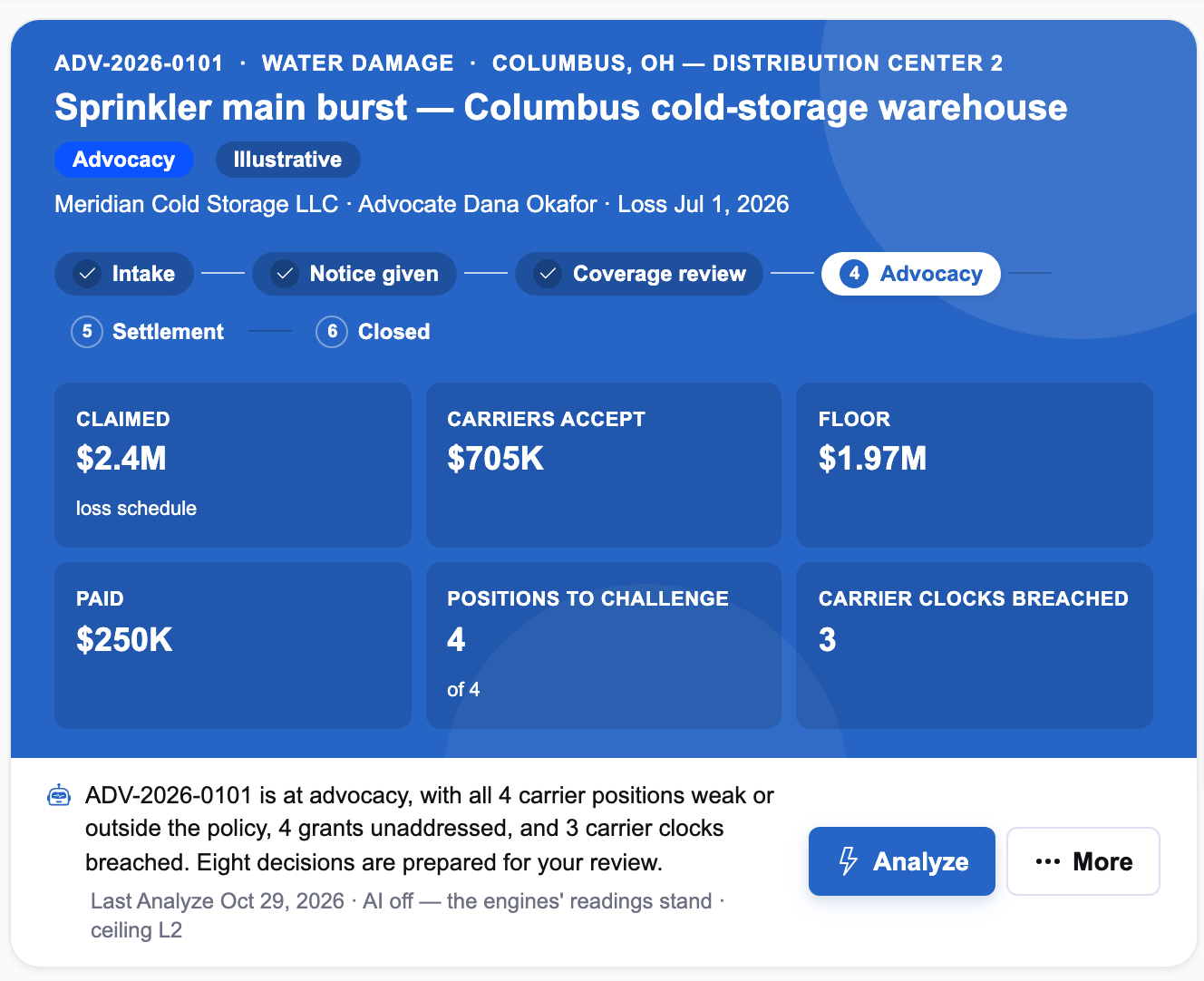
A reservation of rights is a carrier saying “we’re handling this, but we may not pay all of it, and here is why.” The “why” is a list of positions. Each one points at wording. Reading them one at a time, against the policy issued, is the core skill of claims advocacy — and the part InsightAdvocate turns into an engine.
Six kinds of position
| Position | The question to ask | How the engine reads it |
|---|---|---|
| Exclusion | Do the exclusion’s words reach these facts? Is there a carve-back the facts meet? | Carve-back met, or the exclusion’s subject absent from the facts: weak. Otherwise supported. |
| Sublimit | Is the sublimit applied only to its own subject? | Applied to more than the in-subject loss on the schedule: weak. |
| Condition | Has the client done what the condition requires? | Everything the carrier asked for sent, received or waived: weak. Anything outstanding: supported. |
| Not covered | Does any grant in the wording speak to it? | Grants found: weak, and they are quoted. None: needs facts. |
| Late notice | When was notice actually given, against which condition? | On time: not supported. Up to 30 days late: weak (ask about prejudice). Later: supported. |
| General reservation | Which clause? | Names no wording: needs facts. Ask the carrier to say which clause and why. |
And one check before all of them: if the letter cites a clause that the policy issued does not contain, the position is not supported by the policy, whatever kind it is.
the carrier's letter"] --> Q{"Cited clause
in the policy?"} Q -- "no" --> NS["Not supported
by the policy"] Q -- "yes or none cited" --> K{"Kind"} K --> EX["Exclusion:
carve-backs, subject"] K --> SL["Sublimit:
its subject on the schedule"] K --> CO["Condition:
documents outstanding"] K --> NC["Not covered:
grants in the wording"] K --> LN["Late notice:
the notice record"] K --> GR["General:
needs facts"] style NS fill:#fdecec,stroke:#e57373
Two examples from the illustrative book

A seepage exclusion whose last sentence carves back sudden discharge from a sprinkler system — on a burst sprinkler main. A $250K mold sublimit applied to $1.42M of building repair when $180K is mold work. Both weak, both shown with the carrier’s words on the left and the policy’s on the right, and the engine’s reason underneath.

What the letter leaves out
Carriers answer the question in front of them. The engine also lists grants in the wording that the facts put in play and the carrier’s letters never address — debris removal, preservation of property, business income, an employment practices grant on a D&O form. They are often worth more than the positions themselves.

A reading, not a ruling
These are structured readings of positions against the wording on record. They tell an advocate where to look and what to ask. Coverage is decided by the carrier, counsel and, if it comes to it, a court. Nothing here is legal advice.
See the full walk-through in Water damage: four carrier positions, four answers.
